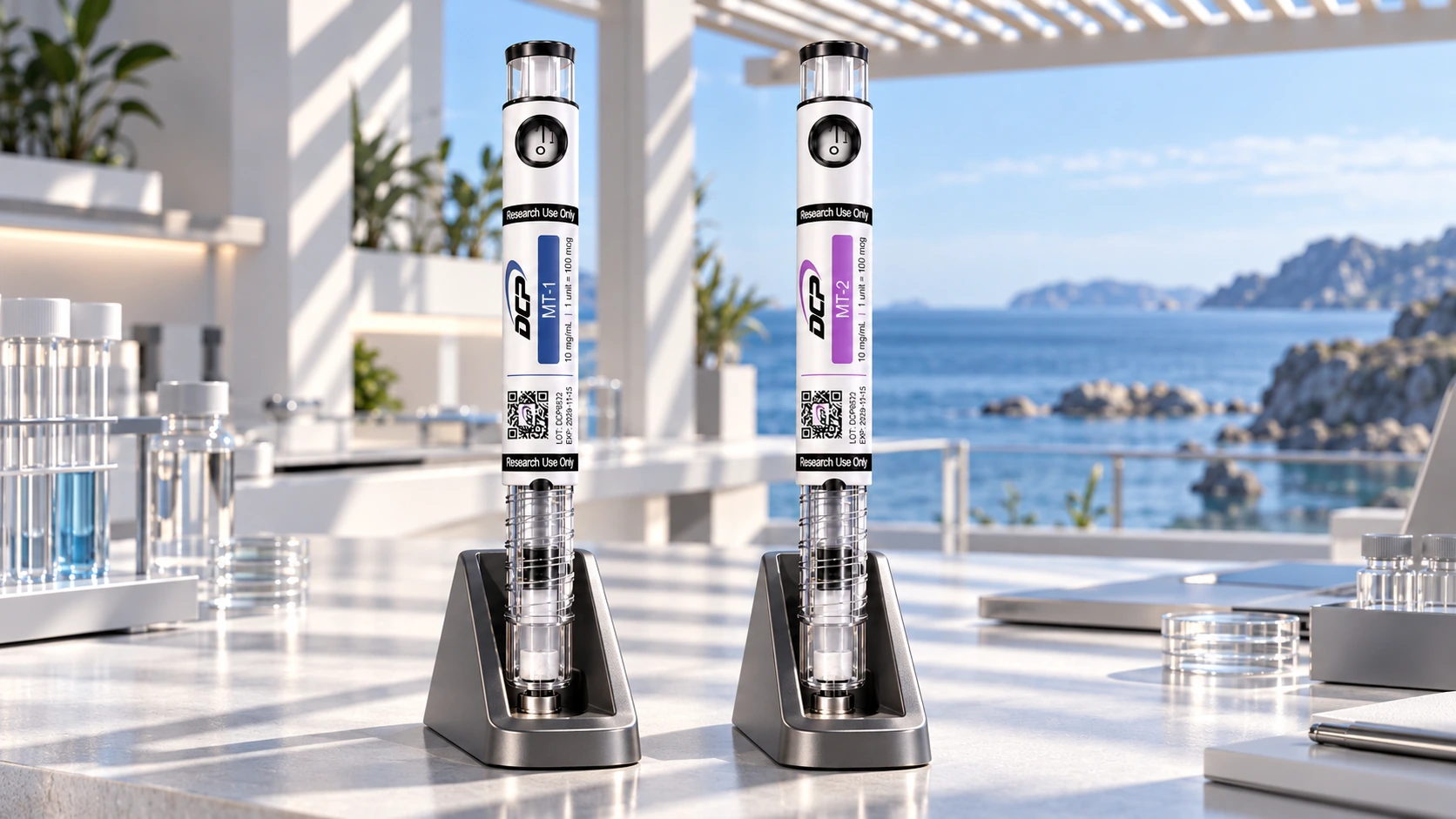
MT-1 and MT-2: Why Molecular Identity Does Not Establish Product Equivalence
Two materials can carry related names without being the same molecule. Two products can contain the same named molecule without having equivalent delivery or clinical evidence. Both distinctions matter when interpreting MT-1, MT-2 and the authorised afamelanotide implant.
The central question is not which container looks more convenient. It is whether the evidence describes the exact substance, formulation and outcome under discussion. Packaging cannot answer that question, and a familiar peptide name cannot resolve it by itself.
Three different claims hidden in one label
“MT-1” is commonly used in connection with Melanotan I or afamelanotide, a linear 13-amino-acid analogue of alpha-MSH. MT-2, or Melanotan II, is a cyclic seven-amino-acid analogue. They are not two concentrations of a single active substance.
Their pharmacology differs as well. Afamelanotide's pigmentation-related activity centres on MC1R, whereas MT-2 has broader melanocortin activity. The EMA product information describes afamelanotide as predominantly binding MC1R, not exclusively doing so. The EMA assessment report provides further regulatory background on its pharmacology and development.
A product label may therefore raise three separate questions: Is the substance correctly identified? Does the finished formulation have demonstrated performance? Is that specific product authorised for a particular clinical use? A positive answer to one does not supply the other two.
What the implant evidence establishes
Afamelanotide was evaluated as an implant in randomized, placebo-controlled trials involving patients with erythropoietic protoporphyria, or EPP. EPP produces painful sensitivity to light, so a clinically relevant question was whether treatment increased time in direct sunlight without pain.
The published trials assessed that outcome alongside measures including quality of life. Comparing active and placebo implants helped address whether the intervention changed patients' experience of the disease, rather than merely documenting a colour change after exposure to a peptide.
This is a useful example of formulation-specific evidence. The intervention was not an unspecified amount of afamelanotide in any presentation. It was an implant studied in a defined patient population, with particular clinical endpoints and follow-up. The measured effect belongs to that complete study context.
The EMA Scenesse overview identifies the authorised implant and its EPP indication. That regulatory status does not transfer to a research vial or cartridge labelled MT-1. It also does not make MT-2 an alternative version of the same medicine.
A formulation is more than its ingredient name
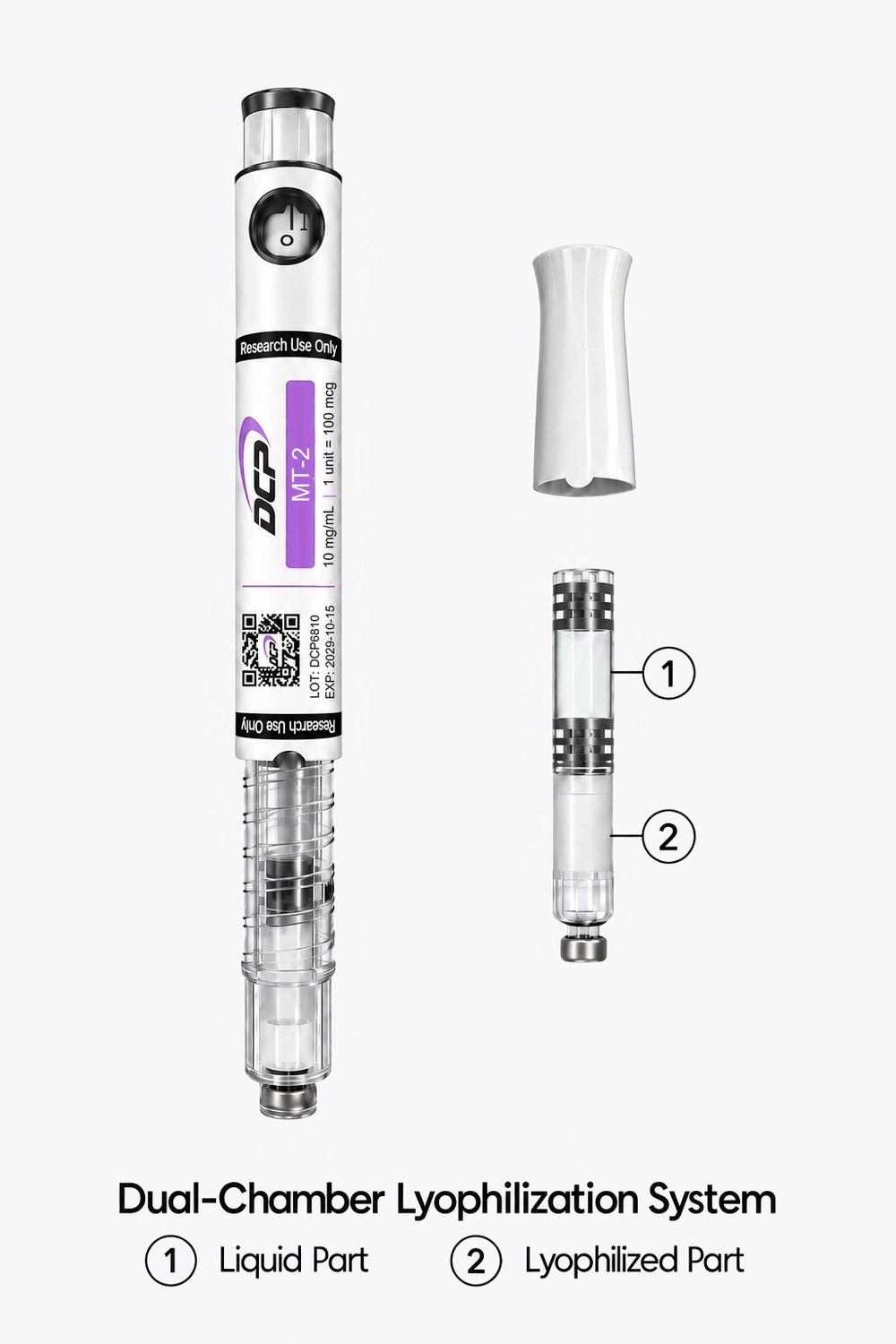
A formulation determines how an active substance is presented and released. An implant and a solution are not interchangeable simply because their labels refer to the same molecule. Release over time, resulting exposure and the characteristics of the finished product need their own evidence.
The distinction runs in both directions. Showing chemical identity does not establish a delivery profile. Showing that a container can hold or dispense a preparation does not establish its molecular integrity, compatibility or clinical performance.
Stability is similarly specific. A meaningful assessment connects the exact formulation and container with defined storage conditions, time points and analytical measurements. Neither the general reputation of a peptide nor a photograph of its presentation supplies those measurements. No stability or delivery guarantee follows from the comparisons in this article.
MT-2 supplies a different, much smaller evidence base
The early Melanotan II phase-I pilot involved three healthy male volunteers receiving subcutaneous MT-II and saline. It reported increased pigmentation in two subjects, alongside effects including nausea, stretching and yawning, spontaneous erections, and somnolence and fatigue. These observations help describe the molecule's human response profile, but they do not establish a broadly acceptable cosmetic treatment.
Crucially, that pilot cannot serve as a bridge between unrelated finished products. It does not show that a different formulation gives equivalent exposure, that a different route reproduces the observations, or that long-term effects are adequately characterized. It also provides no head-to-head evidence that MT-2 is preferable to MT-1.
The MHRA statement adds regulatory safety context concerning potentially serious effects associated with Melanotan II injections and nasal sprays. It is a warning source, not proof of efficacy or support for a delivery claim. Reports of pigment or lesion changes warrant careful interpretation without treating them as either harmless by definition or sufficient proof of cancer causation.
What analytical documentation can resolve
For research material, identity and content are appropriate starting questions. A chromatographic area percentage is not a substitute for either: it describes the relative detector response of peaks under a particular method, rather than independently proving molecular identity, total mass, sterility or endotoxin status.
The method must fit the question. Identity evidence, quantitative content measurements and stability measurements address different uncertainties, and their reports need to match the material being discussed. Our guide to peptide purity testing explains these distinctions without treating a single percentage as a universal quality threshold.
Even extensive analytical characterization would not, by itself, establish clinical equivalence to Scenesse. That is a different evidentiary claim involving the finished product and its clinical performance.
Keep the conclusion attached to the product studied
MT-1 versus MT-2 begins as a molecular comparison, but product equivalence requires more than molecular terminology. The afamelanotide implant trials support conclusions about a defined intervention in EPP; the MT-2 pilot supports limited exploratory observations in a small healthy-volunteer sample.
Neither evidence set validates every presentation bearing a related label. Keeping identity, formulation performance and authorisation separate makes the literature more useful—and prevents a container or ingredient name from being mistaken for clinical evidence.
Explore the Products from This Article
All products are >99% purity, manufactured in a certified EU laboratory, with accompanying lab analysis.
Research Disclaimer
This article is for informational and research purposes only. The content is not intended as medical advice, diagnosis, or treatment recommendation.