Semax and Selank: Why Study Findings Do Not Validate a Delivery System
A compound name is only the first link
A publication about Semax or Selank does not automatically validate every preparation carrying that name. Interpreting a result requires a chain of evidence: the identity of the studied compound, the formulation and route, the exposure achieved, and the outcome measured. A different presentation may share the name while leaving several of those links untested.
Semax and Selank are distinct synthetic peptides, derived from ACTH-related and tuftsin sequences respectively. Their shared appearance in cognitive-research discussions is not evidence of interchangeable activity, compatible co-formulation or combined clinical benefit.
A clinical comparison with a specific boundary
Consider the Selank investigation involving 62 patients with generalized anxiety disorder and neurasthenia. Thirty received Selank and 32 received medazepam, with symptoms assessed through clinical rating scales. This was a patient study addressing anxiety-related outcomes, not a device-performance experiment. Primary study, PMID 18454096.
The active comparator provides a clinical reference, but there was no placebo group to isolate improvement associated with expectations, study participation or symptom fluctuation. Nor should the abstract be read as proving equivalence through a modern blinded equivalence design. Comparable observed ratings are not the same as demonstrating that two treatments differ by less than a prespecified clinically acceptable margin.
The abstract also does not support assigning a specific route to the study. That matters when interpreting a later formulation: a route cannot be supplied retrospectively from a product label. Even a well-supported symptom result would not establish the performance of a delivery system that was not tested.
Route-specific evidence remains route-specific
The 2018 Semax study provides a more explicit route description. It examined intranasal 1% Semax in 24 healthy volunteers, with 14 receiving Semax and 10 placebo. Resting-state functional MRI was performed before administration and at five and twenty minutes afterward, assessing default mode network connectivity. Primary study, PMID 30225715.
This identifies a formulation concentration, route, population and short observation window. It does not establish memory improvement, long-term benefit or equivalent exposure from another preparation. A brain-network response also does not directly measure how much intact peptide reached a particular brain region.
Formulation changes can affect degradation, interaction with container surfaces and the amount of intact material available for delivery. Whether those differences are important must be measured for the specific preparation rather than assumed from the peptide's name.
Separate evidence for identity, delivery and outcome
Analytical identity, peptide content and degradation measurements address what a formulation contains. Delivered-quantity measurements address what leaves its container or device. Pharmacokinetic measurements address exposure in the studied biological compartment. Clinical outcomes address what happens to participants. None of these measurements substitutes for all the others.
Chromatographic area purity is particularly easy to overinterpret: it depends on the method and does not independently establish mass content, identity, sterility or endotoxin status. The distinction is discussed further in peptide purity testing and HPLC.
The missing combination evidence
A 2020 study examined 52 healthy participants in separate Semax, Selank and placebo groups using functional-connectivity outcomes. It was not a trial of a Semax–Selank mixture. Panikratova et al., 2020.
Consequently, it supplies neither combination efficacy evidence nor evidence that the compounds remain compatible in a shared formulation. Those are separate questions requiring separate measurements. The defensible reading of this literature is narrow but useful: specific preparations have been studied for particular imaging or symptom endpoints, while a new formulation or delivery system requires its own supporting evidence.
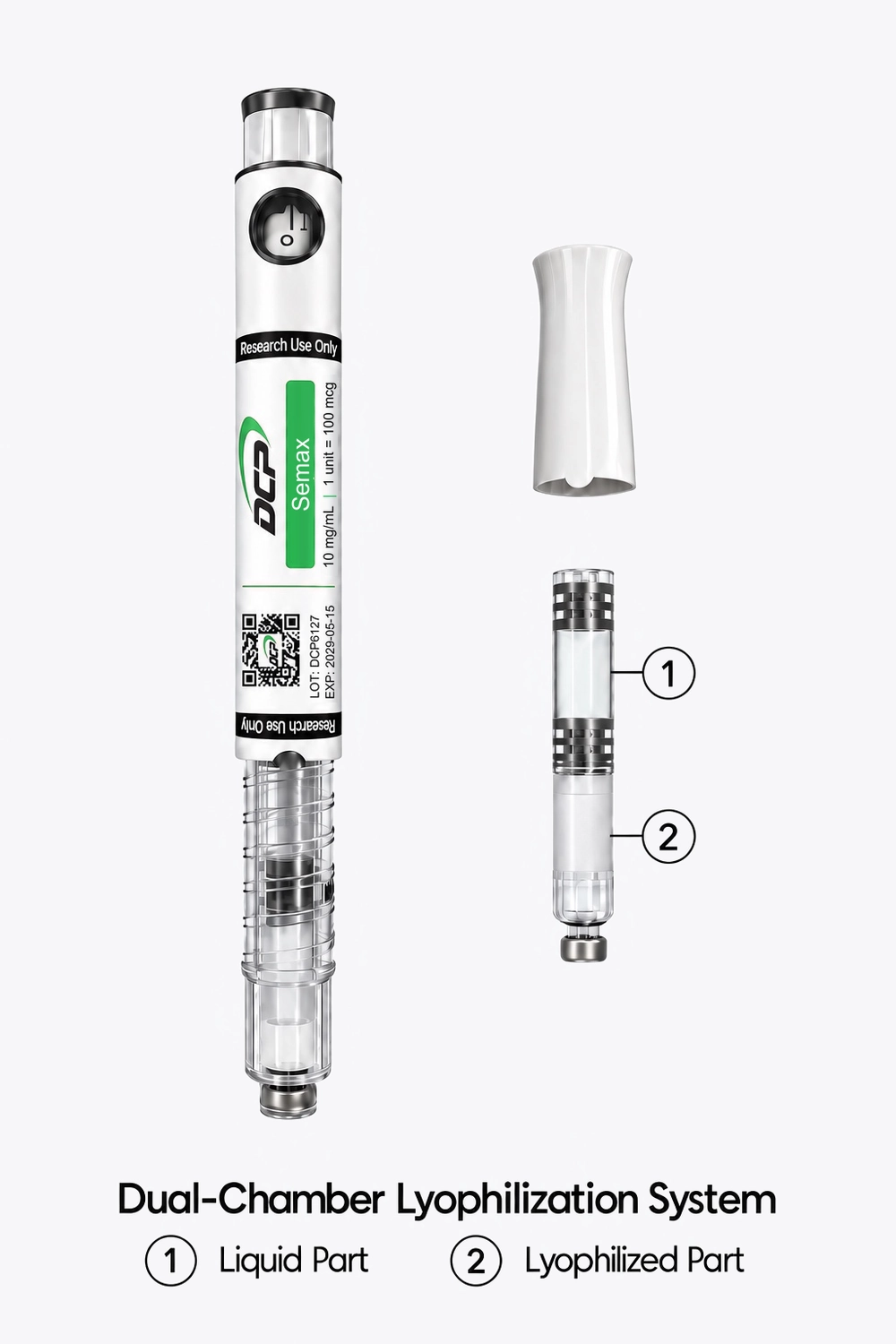
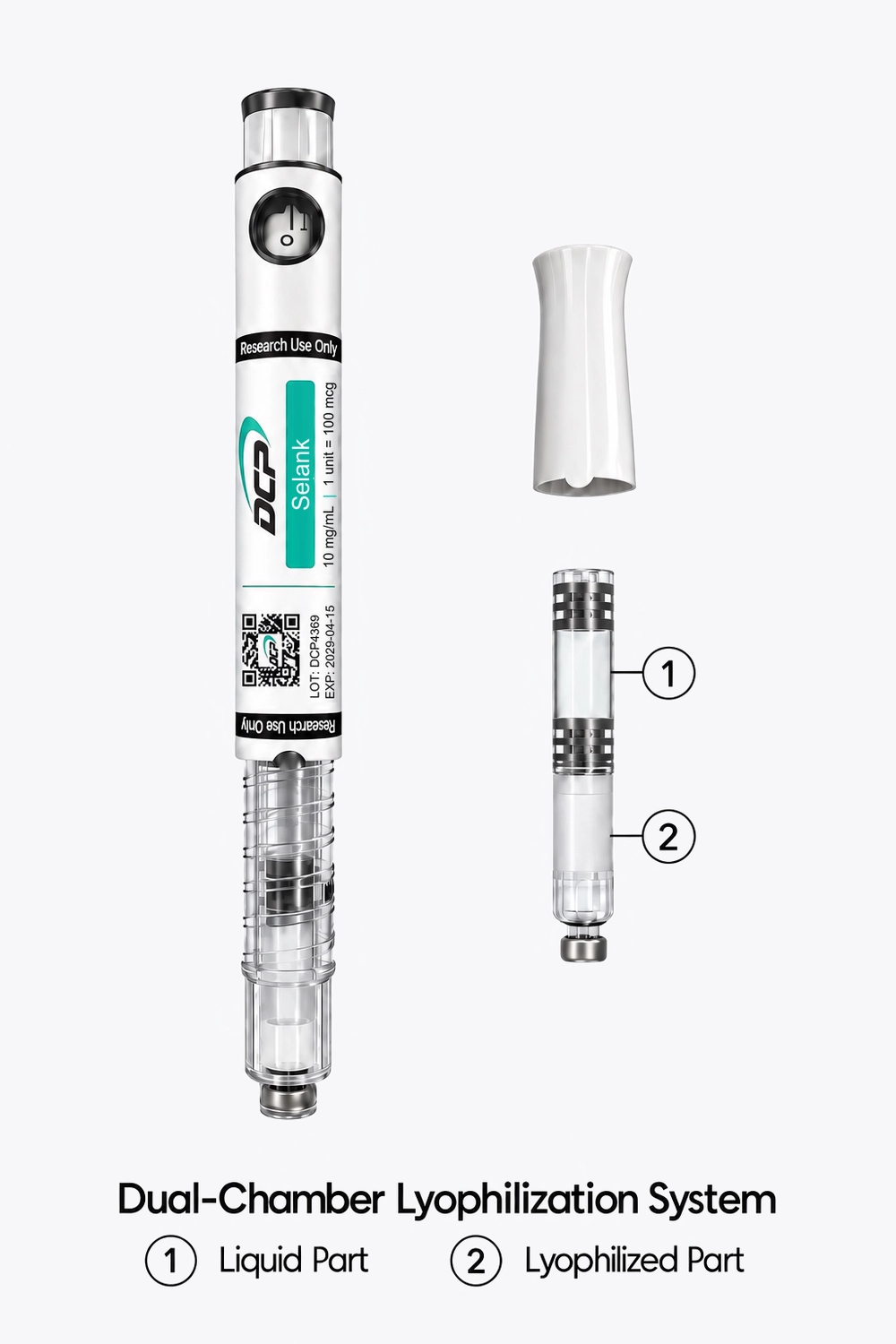
Explore the Products from This Article
All products are >99% purity, manufactured in a certified EU laboratory, with accompanying lab analysis.
Research Disclaimer
This article is for informational and research purposes only. The content is not intended as medical advice, diagnosis, or treatment recommendation.